
As more people bring dogs into their households, we tend to encounter more dogs in everyday life, which makes it even more important to know how to stay safe around them.
Most people are surprised to learn that the majority of dog bites happen from dogs people know — not stray dogs. In fact, studies show about 77% of dog bite victims are bitten by a familiar dog, often their own family dog, a friend’s dog, or a neighbor’s dog.
The good news is that many dog bites are preventable when children and adults learn how to better understand canine body language, boundaries, and safe interactions.
Want a simple dog safety guide you can keep and share?
I created a free Feeling Safe Around Dogs guide with practical tips to help children, adults, and families better understand dogs, respect boundaries, and feel safer around them.
Download the guide here.
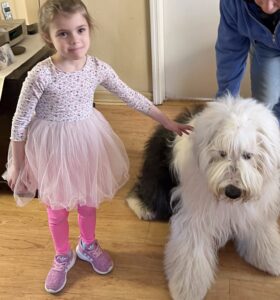
As a Humane Educator for over 30 years, I teach kindness, compassion, and respect for all living beings, including animals, people, and the environment. My work includes helping children and adults better understand animal behavior, responsible pet guardianship, and safety around animals.
Part of my work included teaching dog bite prevention programs in classrooms throughout the San Francisco Bay Area. I saw firsthand how important it is for both children and adults to understand dogs’ behavior and body language so everyone can stay safe around them.
Julie, my Animal Communication client and life-long dog lover, recently emailed me to thank me for my advice for staying safe around her relatives’ dogs.
“I took your advice and have been very careful around my husband’s relatives’ dogs, who tend to be unruly and out of control when people arrive. I won’t enter my in-laws’ house unless their Labradoodle, Jagger, is on a leash or behind a fence because my poor little nephew went inside, and the dog jumped on him, slamming his head against the wall.
I’m the same way with my niece’s rescue terrier mix, Buddy, who has bitten two more people since we last spoke, one bite quite severe. One time, my niece came outside to find me sitting on her front steps. She asked why. I told her I didn’t know where her dog was, and I wasn’t willing to take the chance.”
Julie is not alone. I hear stories like hers all the time from family members and dog professionals, too.
The Pressure to be “Polite”
My groomer told me today that she was bit twice by an elderly dog when she took her off the grooming table. The dog’s owner had alluded she was reactive but not in a clear way. My groomer felt distraught and bad that she didn’t want to groom the dog anymore.
I encouraged her to put her safety first. She felt relieved when I said this.
Whether you’re like Julie visiting relatives or simply out for a walk, the pressure to be “polite” often overrides staying safe.
Fear of Dogs Is More Common Than You Think
Fear of dogs is more common in children. While not everyone has a true dog phobia, many people feel unsure or unsafe around dogs. That’s why learning how to stay safe and read a dog’s behavior is so important.
From reasonable caution around a dog you don’t trust, like Julie, to fear so overwhelming it affects daily life, fear looks different for everyone.
When we treat children’s fear of dogs as no big deal or something to push through, we create an unsafe situation for the child and the dog.
What the Dog Is Actually Telling You
When a dog jumps on a guest or bites someone, they are communicating, telling you exactly how they feel.
A large dog like Jagger, who jumps and lunges when guests arrive, is often overwhelmed with excitement, but most likely hasn’t been shown a calm way to greet guests. He just doesn’t know a different way. At a certain size and force, the consequences can be serious.
A dog like Buddy, who has bitten more than once, has learned something: the bite works. It creates distance.
His people know he is fearful, yet continue to put him in situations where biting feels like his only way out. He is not asking to be feared. He is asking for space, and without intervention, his life is at risk.
Keeping everyone safe, including the dog, means setting them up for success in situations that may feel overwhelming or scary.
What We Teach Children Without Realizing It
My dog Yogi Bear and I were at a dog park recently when we came across a little girl with her family and a couple of Labradoodles. One of the dogs had cornered her against a fence, and she began to cry. The adults around her were quick to minimize her reaction: “he didn’t mean any harm,” “You shouldn’t be afraid.”
But the dog’s intentions were beside the point. What this little girl needed was to feel safe and have her feelings validated, not dismissed. The message she received instead was: “Your fear is wrong. The dog matters more than your feelings.”
We teach children to override their instincts when we do this. And those instincts exist for a reason: to protect us. When a child or an adult feels hesitant or fearful around a dog, their body is picking up on important signals, whether it’s the dog’s size, intense energy, or a lack of predictable boundaries.
These “gut feelings” are essential survival tools designed to keep us out of harm’s way.
You don’t need to apologize for keeping yourself or your child safe around dogs.
It’s okay to call ahead and ask that the dog be leashed or put in another room before you arrive. It’s okay to wait outside.
It’s okay to leave.
Your safety and your child’s come first.
Help your family feel safer and more confident around dogs.

Download my free Feeling Safe Around Dogs guide to learn practical ways to better understand dogs, respect their boundaries, and create safer interactions for both people and dogs.
if you found this helpful, please leave a comment below. We’d love to hear about your experiences.